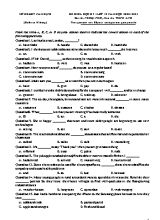

Đề khảo sát chất lượng môn Tiếng Anh Lớp 12 - Mã đề 260 - Năm học 2018-2019 - Sở giáo dục và đào tạo Long An
Xem trước nội dung
Trang 1/5
SỞ GD & ĐT LONG AN
ĐỀ CHÍNH THỨC
(Đề có 5 trang)
ĐỀ KHẢO SÁT CHẤT LƯỢNG LỚP 12
NĂM HỌC 2018 - 2019
MÔN: TIẾNG ANH Thời gian : 60 phút; (Đề có 50 câu)
Full Name : ............................................................... No : ...................
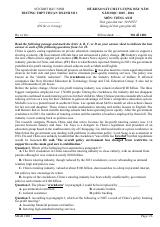
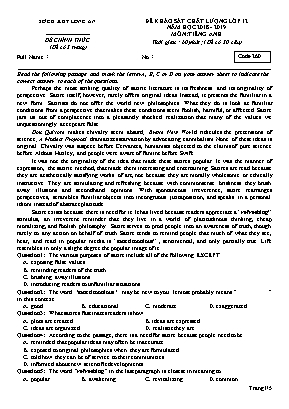
Read the following passage and mark the letter A, B, C or D on your answer sheet to indicate the correct answer to each of the questions.
Perhaps the most striking quality of satiric literature is its freshness and its originality of perspective. Satire itself, however, rarely offers original ideas. Instead, it presents the familiar in a new form. Satirists do not offer the world new philosophies. What they do is look at familiar conditions from a perspective that makes these conditions seem foolish, harmful, or affected. Satire jars us out of complacence into a pleasantly shocked realization that many of the values we unquestioningly accept are false.
Don Quixote makes chivalry seem absurd; Brave New World ridicules the pretensions of science; A Modest Proposal dramatizes starvation by advocating cannibalism. None of these ideas is original. Chivalry was suspect before Cervantes, humanists objected to the claims of pure science before Aldous Huxley, and people were aware of famine before Swift.
It was not the originality of the idea that made these satires popular. It was the manner of expression, the satiric method, that made them interesting and entertaining. Satires are read because they are aesthetically satisfying works of art, not because they are morally wholesome or ethically instructive. They are stimulating and refreshing because with commonsense briskness they brush away illusions and secondhand opinions. With spontaneous irreverence, satire rearranges perspectives, scrambles familiar objects into incongruous juxtaposition, and speaks in a personal idiom instead of abstract platitude.
Satire exists because there is need for it. It has lived because readers appreciate a “refreshing” stimulus, an irreverent reminder that they live in a world of platitudinous thinking, cheap moralizing, and foolish philosophy. Satire serves to prod people into an awareness of truth, though rarely to any action on behalf of truth. Satire tends to remind people that much of what they see, hear, and read in popular media is “sanctimonious”, sentimental, and only partially true. Life resembles in only a slight degree the popular image of it. Question1: The various purposes of satire include all of the following EXCEPT …………….
A. exposing false values B. reminding readers of the truth C. brushing away illusions D. introducing readers to unfamiliar situations Question2: The word "sanctimonious" may be new to you. It most probably means "……………." in this context.
A. good B. educational C. moderate D. exaggerated Question3: What satires fascinates readers is how…………….
A. plots are created B. ideas are expressed C. ideas are organized D. realistic they are Question4: According to the passage, there is a need for satire because people need to be …………
A. reminded that popular ideas may often be inaccurate B. exposed to original philosophies when they are formulated C. told how they can be of service to their communities D. informed about new scientific developments Question5: The word "refreshing" in the last paragraph is closest in meaning to …………….
A. popular B. awakening C. revitalizing D. common
Code 260
DeThi.edu.vn
Trên đây là phần đầu tài liệu — bấm Đọc sách để xem đầy đủ.