
Bài tập Tiếng Anh Lớp 11 - Unit 8 Our world heritage sites
Xem trước nội dung
UNIT 8
OUR WORLD HERITAGE SITES (LANGUAGE FOCUS)
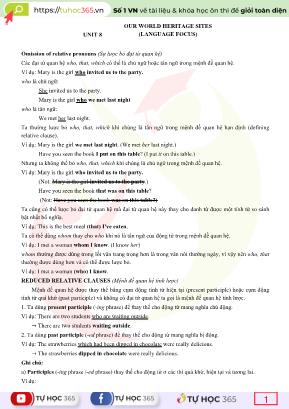
Omission of relative pronouns (Sự lược bỏ đại từ quan hệ)
Các đại từ quan hệ who, that, which có thể là chủ ngữ hoặc tân ngữ trong mệnh đề quan hệ.
Ví dụ: Mary is the girl who invited us to the party.
who là chủ ngữ:
She invited us to the party.
Mary is the girl who we met last night
who là tân ngữ:
We met her last night.
Ta thường lược bỏ who, that, which khi chúng là tân ngữ trong mệnh đề quan hệ hạn định (defining relative clause).
Ví dụ: Mary is the girl we met last night. (We met her last night.)
Have you seen the book I put on this table? (I put it on this table.)
Nhưng ta không thể bỏ who, that, which khi chúng là chủ ngữ trong mệnh đề quan hệ.
Ví dụ: Mary is the girl who invited us to the party.
(Not: Mary is the girl invited us to the party.)
Have you seen the book that was on this table?
(Not: Have you seen the book was on this table?)
Ta cũng có thể lược bỏ đại từ quan hệ mà đại từ quan hệ này thay cho danh từ được một tính từ so sánh bật nhất bổ nghĩa.
Ví dụ: This is the best meal (that) I've eaten.
Ta có thể dùng whom thay cho who khi nó là tân ngữ của động từ trong mệnh đề quan hệ.
Ví dụ: I met a woman whom I know. (I know her)
whom thường được dùng trong lối văn trang trọng hơn là trong văn nói thường ngày, vì vậy nên who, that thường được dùng hơn và có thể được lược bỏ.
Ví dụ: I met a woman (who) I know.
REDUCED RELATIVE CLAUSES (Mệnh đề quan hệ tỉnh lược)
Mệnh đề quan hệ được thay thế bằng cụm động tính từ hiện tại (present participle) hoặc cụm động tính từ quá khứ (past participle) và không có đại từ quan hệ ta gọi là mệnh đề quan hệ tỉnh lược.
1. Ta dùng present participle (-ing phrase) để thay thế cho động từ mang nghĩa chủ động.
Ví dụ: There are two students who are waiting outside.
→ There are two students waiting outside.
2. Ta dùng past participle (-ed phrase) để thay thế cho động từ mang nghĩa bị động.
Ví dụ: The strawberries which had been dipped in chocolate were really delicious.
→ The strawberries dipped in chocolate were really delicious.
Ghi chú:
a) Participles (-ing phrase /-ed phrase) thay thế cho động từ ở các thì quá khứ, hiện tại và tương lai.
Ví dụ:
1 DeThi.edu.vn
The winner is the person who scored / scores / will score the most points in the game.
→ The winner is the person scoring the most points in the game.
First prize is for the most points which were scored / are scored / will be scored in the game.
→ First prize is for the most points scored in the game.
b) Participles (-ing phrase /-ed phrase) cũng có thể được dùng trong mệnh đề quan hệ không hạn định, thường được dùng trong lối văn mô tả và tường thuật.
Ví dụ:
The old car, trailing black smoke, drove off towards town. (= which was trailing black smoke)
Robert Ball, nicknamed 'Big Bob', was my favourite teacher. (= who was nicknamed)
c) Not dùng để đặt trước một ngữ phân từ trong mệnh đề quan hệ rút gọn ở hình thức phủ định.
Ví dụ:
My parents, not having much money, never went on holiday. (= who didn't have)
I'd prefer shirts not made with polyester if you have any. (= which aren't made)
3. Ta dùng to-infinitive (không dùng ngữ phân từ) khi danh từ được thay thế bằng đại từ quan hệ được bổ nghĩa bằng tính từ so sánh bậc nhất hoặc được những từ như first, second, only, last, next v.v bổ nghĩa.
Ví dụ: Neil Armstrong was the first person who walked on the moon.
→ Neil Armstrong was the first person to walk on the moon.
(NOT: Ned Armstrong was the first person walking on the moon.)
Hoặc dùng to - infinitive để thay thế cho mệnh đề quan hệ mang ý nghĩa chỉ mục đích.
Ví dụ:
English is an important language which we have to master.
→ English is an important language to master.
This is a wonderful restaurant where we can have dinner.
→ This is a wonderful restaurant to have dinner.
PRACTICE TEST 1
A. LANGUAGE
I. PRONUNCIATION
Exercise 1: Choose the word whose underlined part is pronounced differently from the others.
1. A. …
Trên đây là phần đầu tài liệu — bấm Đọc sách để xem đầy đủ.